
 I missed the semifinal World Cup game Brazil vs Germany yesterday afternoon. I was commuting and checking in disbelief the score on an app on my phone. By the time I got home, it was half time, and by then there was no point in watching it anymore. (I’m happy to see many positive messages starting to pop up, as it relates to our personal and spiritual growth, during “good” and “bad” times, but this article is not about the World Cup.)
On my way home as I followed the game, I thought how nice it would be if the box of chocolate my mother had mailed to me last week would have arrived. It would at least be something good to balance the events of that afternoon. I imagined two scenarios: either there would be a delivery note in my mailbox for me to pick it up, or as it happened once before, the postman would have left the box there for me, even without a signature.
 How is your spiritual practice? How long have you been in it? Is there room to simplify it? Or does it need to be more complex instead?
 During one of my meditations a week ago, I was thinking about the fact that I had been stuck with one of my projects once again, and was trying to find answers. The project is the short story I wrote a while back, and I have been adding to it and editing for several months now, as I intend to publish it this year. During the meditation I sought answers of why this was happening. I asked why I was procrastinating and not working on it, while time was passing and I wasn’t making anything happen.
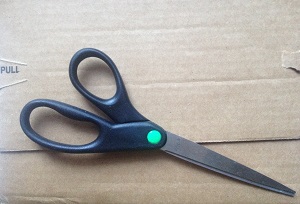 After having a day of unfortunate events, I hoped for some good news, or at least to get home and have a book I had ordered by my door. I had checked the tracking number and knew that it was going to be delivered that day, but I couldn’t stay home to wait for it. Late in the evening, when I got home and checked my mailbox, I saw the box with the book stuck in it, in a diagonal position. I had a split second of happiness and excitement for the book’s arrival, and relief for not having to go to the Post Office the next day; only to realize that the box was stuck. I removed the rest of the mail that was easy to reach. Then, I tried to remove the box by folding the edges on both ends, and nothing. I took off my coat, so that my arm would fit inside the mailbox and reach the end of the package, and I started pushing it. It didn’t work either. I kept trying to use strength for a while, without success. I tried to use the string that helps open boxes, but it was facing down, and I couldn’t move it too far. The thought of going upstairs to pick up scissors crossed my mind, but I didn’t really feel like it.
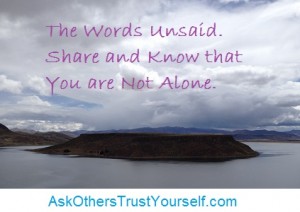 Early in February, I wrote in my journal “The words unsaid”. I had attended an all-day women’s workshop and was touched by the bravery of those willing to go on the “hot seat”. It turns out that we had more things in common than we could think or imagine. When we share, and don’t keep words unsaid, we learn that we are not alone, and we serve as an example and support for others. Your sharing may give someone else the permission they need to speak up, and to ask for support.
 I wrote Ask Others, Trust Yourself a few years ago out of my desire to help clients who had been stuck for many years, or who were afraid of pursuing their business for whatever reason, or who specifically became stuck due to negative feedback, or who thought they had to do it all and never asked for help.
 When I first started coaching entrepreneurs nine years ago, I was nervous. I asked a friend and colleague what to do if I didn’t know an answer to my first client’s questions. She wisely recommended that I could say I didn’t know, but would research it. What a relief! I didn’t have to know all the answers. Almost ten years later, it’s rarely the case that I don’t have an answer, but I realized that it’s not important to have answers at all. The key is to help others figure out the answers on their own, and to ask great questions.
 After I published the article “